




Introduction
Enterprise brands operate across long buying cycles, multiple decision-makers, and diverse digital touchpoints. In this context, isolated campaigns or channel-specific optimizations are insufficient. A full-funnel marketing approach provides a structured way to align digital marketing strategy with how enterprise buyers actually evaluate, compare, and commit to solutions.
This article outlines how a full-funnel digital marketing strategy functions at the enterprise level, why it differs from mid-market execution, and how enterprise marketing services can be structured to support sustained growth rather than short-term performance spikes.
Defining Full-Funnel Marketing in an Enterprise Context
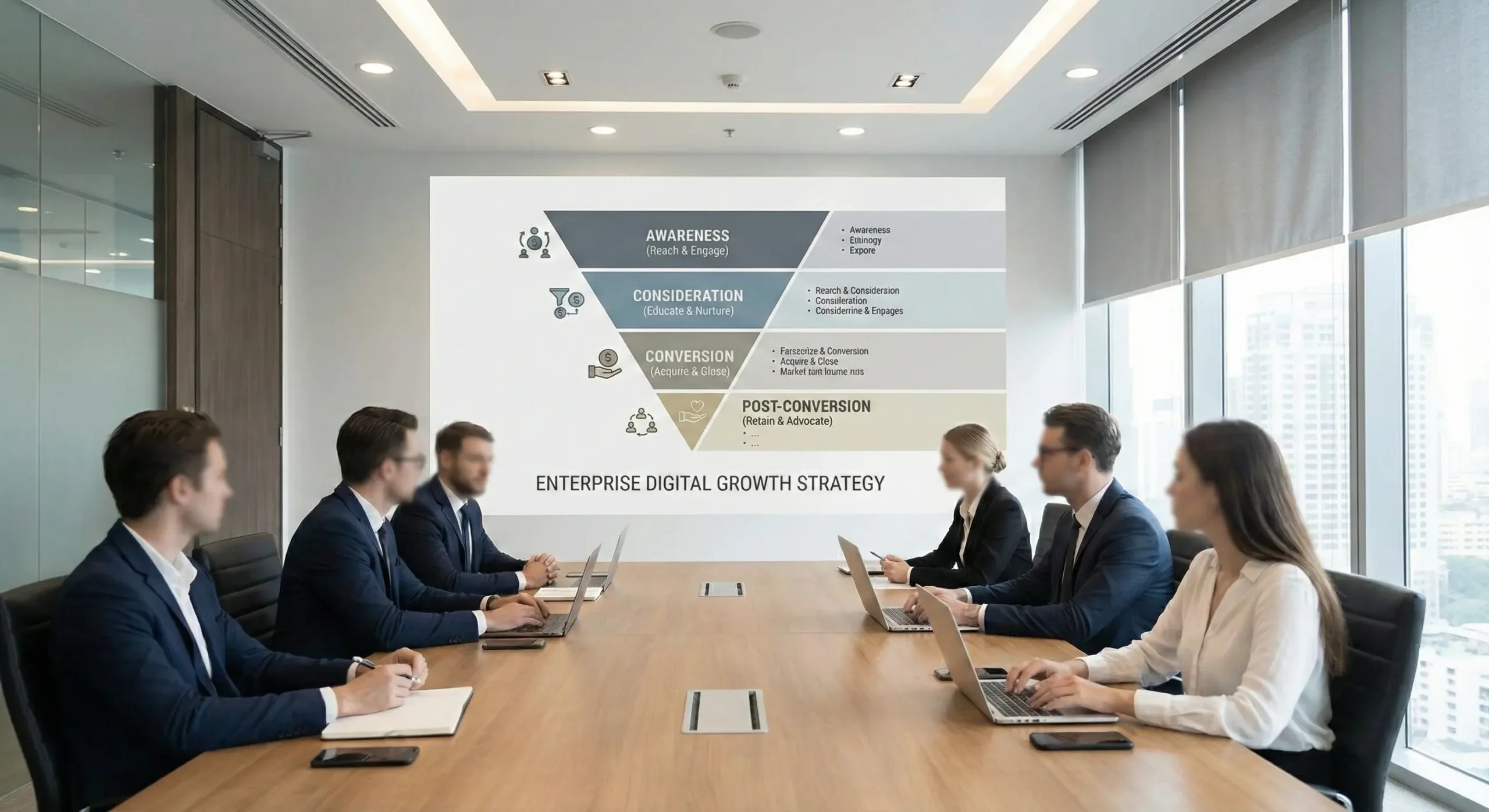
Full-funnel marketing refers to the coordinated management of awareness, consideration, conversion, and post-conversion stages. For enterprise brands, this funnel is not linear. Prospects often enter and exit at different stages, influenced by internal alignment, budget cycles, and risk assessment.
A practical full-funnel marketing model focuses on information flow rather than persuasion. Each stage addresses a specific decision requirement: problem recognition, solution validation, vendor comparison, and implementation confidence. Digital channels are selected based on their ability to deliver that information reliably.
Why Enterprise Brands Require a Distinct Digital Marketing Strategy
Enterprise buyers do not convert based on single interactions. Decisions are distributed across teams, often over months. As a result, a digital marketing strategy for enterprise brands must prioritize consistency, traceability, and governance.
This requires systems that can manage message continuity across paid media, organic search, content platforms, and direct channels. It also requires clear ownership of data, attribution logic that reflects long sales cycles, and integration with CRM and internal reporting structures.
Without these elements, growth funnel analysis becomes fragmented, and marketing performance is reduced to isolated metrics rather than decision influence.
Top-of-Funnel: Structured Demand Awareness
At the top of the growth funnel, the objective is not lead capture. It is category and problem definition. Enterprise audiences are often aware of symptoms but lack a shared internal language to frame the problem.
Effective top-of-funnel execution focuses on search visibility for problem-oriented queries, neutral educational content, and controlled reach through paid distribution. The role of digital marketing strategy here is to establish relevance and credibility without forcing engagement.
Measurement at this stage prioritizes qualified reach, content consumption patterns, and repeat exposure rather than form submissions.
Mid-Funnel: Evaluation and Internal Alignment
The middle of the funnel is where enterprise deals are shaped. Buyers compare approaches, assess operational fit, and build internal consensus. Content and channel strategy must support this internal process.
This stage benefits from detailed comparison assets, use-case documentation, and technically accurate explanations of delivery models. Retargeting and email distribution are used to maintain continuity, not pressure.
Enterprise marketing services at this level focus on mapping content to stakeholder roles and ensuring that messaging remains consistent across departments and regions.
Bottom-of-Funnel: Risk Reduction, Not Persuasion
At the bottom of the funnel, the primary barrier is risk. Enterprise buyers are less concerned with features and more concerned with execution reliability, scalability, and accountability.
Digital assets at this stage include implementation frameworks, service scope clarity, and evidence of process maturity. Calls to action are informational, such as requesting documentation or initiating a structured discussion.
A full-funnel marketing approach treats conversion as a validation step rather than a closing tactic.
Post-Conversion: Funnel Continuity and Expansion
For enterprise brands, the funnel does not end at conversion. Post-conversion communication supports onboarding, adoption, and internal justification of the decision.
Digital channels are used to reinforce decision confidence through documentation, reporting visibility, and performance transparency. This stage directly impacts expansion opportunities and long-term account stability.
Including post-conversion stages in the growth funnel allows marketing and delivery teams to operate from shared data rather than separate objectives.
Integrating Channels Into a Single Funnel Framework
A common failure in enterprise digital marketing strategy is channel fragmentation. SEO, paid media, content, and automation often operate independently, each optimized for local metrics.
A full-funnel model requires shared definitions of funnel stages, aligned KPIs, and centralized data interpretation. Channels are evaluated based on their role in moving prospects between decision stages, not their individual performance.
This integration enables more accurate forecasting and reduces dependency on short-term optimizations.
Role of Enterprise Digital Marketing Services in Funnel Execution
Enterprise marketing services are most effective when structured as operational support rather than campaign delivery. This includes funnel design, data architecture, process documentation, and ongoing optimization based on observed decision behavior.
Agencies operating at this level function as systems partners. Their value lies in maintaining alignment between strategy, execution, and measurement over time.
Primelane Web Agency approaches enterprise engagement through this operational lens, focusing on building durable funnel systems rather than isolated marketing outputs.
Conclusion
A full-funnel digital marketing strategy provides enterprise brands with a structured way to manage complexity, align stakeholders, and support long-term growth. Its effectiveness depends on disciplined execution, clear definitions, and realistic measurement frameworks.
Brands evaluating this approach should assess whether their current digital marketing strategy reflects actual buyer behavior or merely channel performance.
For organizations seeking a practical discussion on structuring or refining an enterprise growth funnel, Primelane Web Agency provides detailed consultations focused on systems, data, and execution alignment rather than promotional claims.