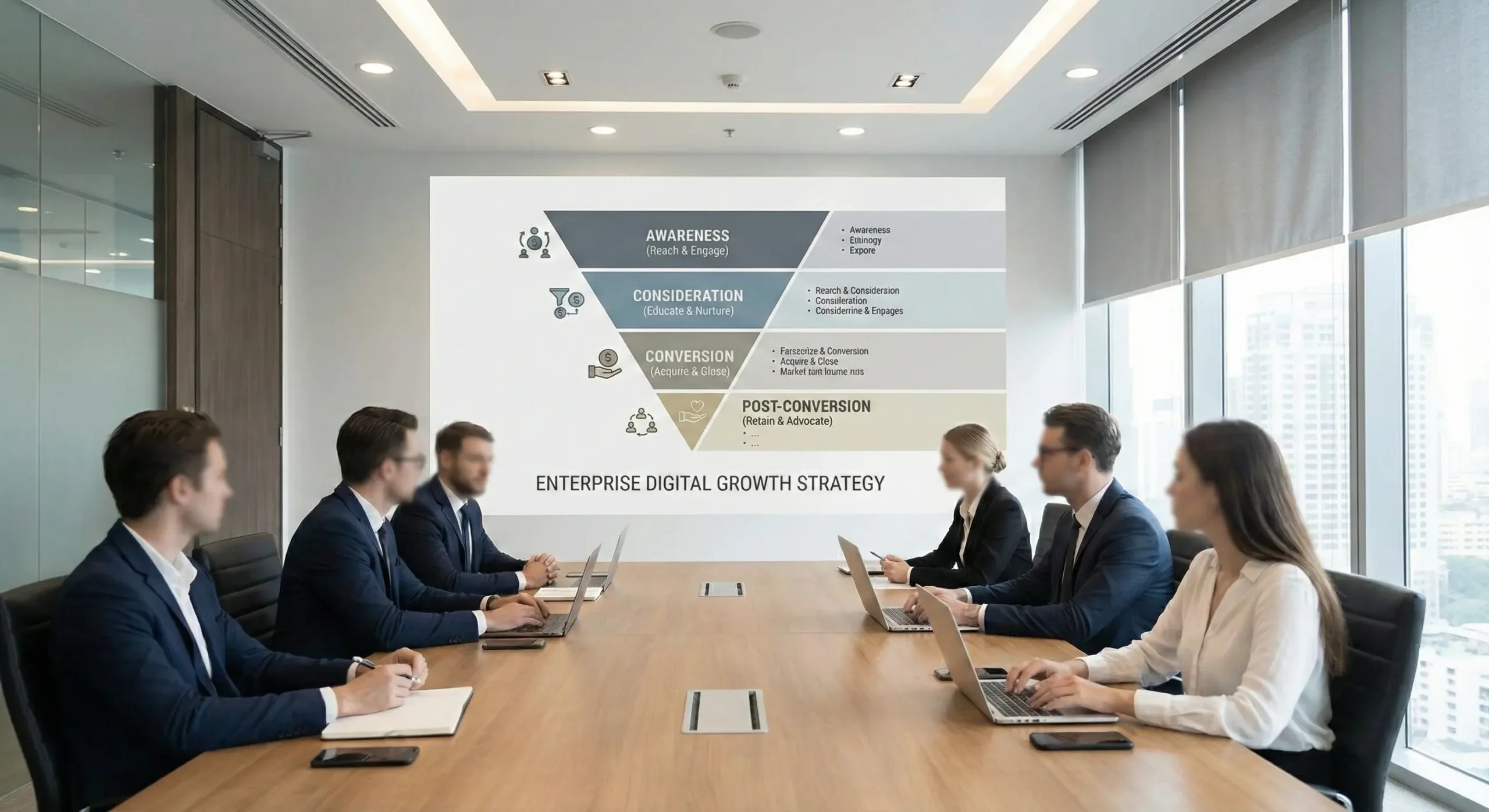





Product-led growth (PLG) shifts customer acquisition, activation, and expansion toward the product itself. In this model, the website is not a promotional surface. It is a functional extension of the product that supports discovery, evaluation, and onboarding. SaaS website development for PLG therefore requires different priorities than traditional marketing-led sites.
This article examines how SaaS website development supports scalable product-led growth through structure, UX decisions, and conversion logic, with a focus on clarity rather than persuasion.
The Role of the Website in Product-Led Growth
In a PLG motion, users often encounter the website before any sales interaction. The website must help them understand whether the product solves a specific problem and how quickly they can validate that assumption. This makes the website part of the product experience rather than a pre-sales artifact.
A PLG-oriented SaaS website prioritizes decision support. It answers practical questions: what the product does, who it is for, how it works, and what happens after sign-up. Each of these answers should be accessible without forcing users into marketing funnels.
SaaS Website Development as a Systems Problem
SaaS website development for PLG is a systems problem, not a design exercise in isolation. The website must integrate with authentication, onboarding flows, analytics, documentation, and support systems. Decisions made at the website level affect activation rates, trial completion, and self-serve conversion.
For example, a “Get Started” action is not simply a button. It is an entry point into an account state, a data model, and a user journey. Poor alignment between the website and the product backend creates friction that undermines PLG objectives.
Conversion-Focused Web Design Without Sales Pressure
Conversion-focused web design in a PLG context differs from traditional lead generation. The primary conversion is often account creation or product access, not form submission. This changes how success is defined.
Effective conversion-focused SaaS web design reduces uncertainty rather than amplifying desire. It clarifies what the user will experience after clicking, what effort is required, and what limitations exist. This transparency improves conversion quality, even if it reduces raw sign-up volume.
Clear pricing logic, explicit feature boundaries, and visible onboarding steps contribute more to sustainable growth than persuasive copy. Users who convert with accurate expectations are more likely to activate and retain.
SaaS UX and Self-Serve Evaluation
SaaS UX begins before the user enters the product. Navigation structure, page hierarchy, and content sequencing influence how users evaluate fit. In PLG models, users perform this evaluation independently.
A well-structured SaaS UX supports comparison without overload. Feature pages should explain function, context, and constraints. Use cases should map to real workflows rather than abstract benefits. Documentation and help resources should be accessible without requiring an account.
This approach respects the user’s decision process and reduces reliance on sales intervention.
Content Structure Over Persuasion
In PLG-oriented SaaS websites, content structure matters more than copy tone. Pages should follow a logical progression: problem definition, solution mechanics, implementation considerations, and next steps. Each section should answer a distinct question.
Avoid blending multiple ideas into a single paragraph. For example, do not explain a feature, its benefit, and its pricing impact at the same time. Separating these concepts improves comprehension and reduces cognitive load.
This structure supports faster decision-making and aligns with how technical and operational buyers evaluate software.
Scalability Through Consistent Patterns
Scalable SaaS website development relies on consistency. Design patterns, content modules, and interaction logic should be reusable across pages and product lines. This reduces maintenance cost and supports faster iteration as the product evolves.
Consistency also improves user orientation. When navigation, layout, and terminology remain stable, users spend less time learning the interface and more time evaluating the product itself. This is particularly important for SaaS platforms with expanding feature sets.
From a PLG perspective, consistency supports scale by enabling users to self-serve without repeated explanation.
Analytics as a Feedback Mechanism
In product-led growth, website analytics should focus on behavior, not vanity metrics. Key signals include time to first action, drop-off points in onboarding-related flows, and transitions from website pages to in-product states.
SaaS website development should account for these measurement needs from the outset. Event tracking, attribution logic, and experimentation frameworks must be integrated at the architectural level. Retrofitting analytics after launch often produces incomplete data.
This feedback loop allows teams to refine website UX based on observed user behavior rather than assumptions.
The Role of Web Agencies in PLG Execution
Web agencies working with SaaS companies in PLG models must operate beyond surface-level design. The work involves aligning business goals, product logic, and user behavior into a coherent system.
At Primelane Web Agency, SaaS website development is approached as part of the product growth infrastructure. The focus is on building websites that support self-serve discovery, reduce friction in early user journeys, and scale alongside the product roadmap.
This requires collaboration with product, engineering, and growth teams rather than isolated delivery.
A Practical Next Step
If you are evaluating whether your current SaaS website supports product-led growth, start by mapping user actions from the first visit to initial product value. Identify where the website clarifies decisions and where it introduces uncertainty.
For teams seeking a structured review or redesign aligned with PLG principles, Primelane Web Agency provides advisory and implementation support focused on SaaS UX, conversion-focused web design, and scalable website systems. An initial assessment can help determine whether changes are required at the content, UX, or architecture level.
Tags: Custom CMS